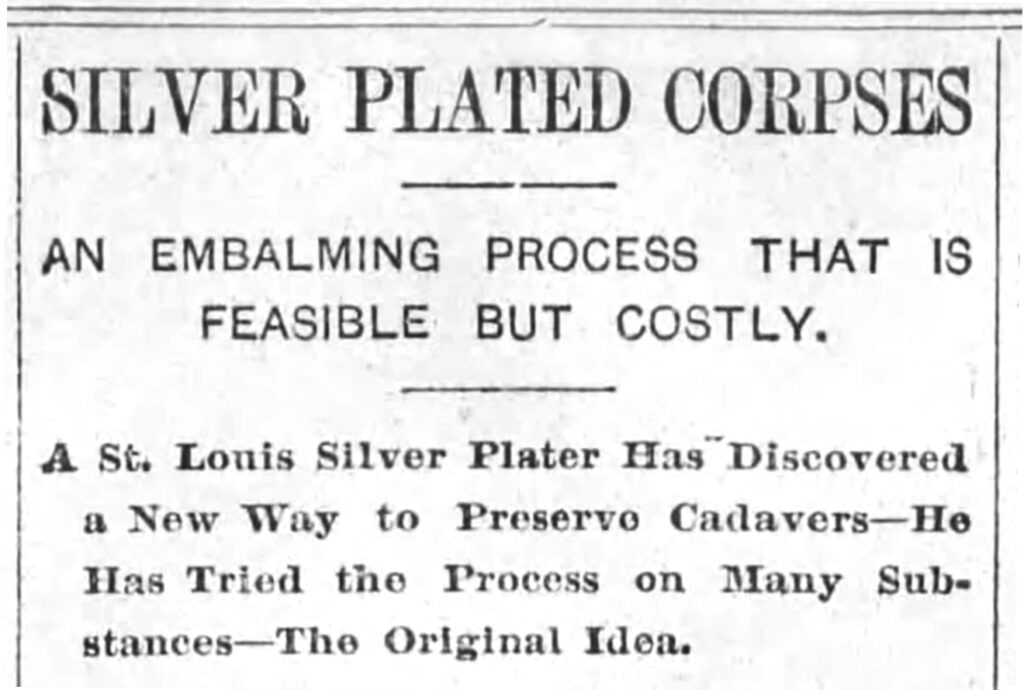
What if instead of burying the dead, we made statues out of them? In 1890, a St. Louis silver plater named Samuel Downing claimed to have found an unusual and creative new way to embalm the dead: preserving them in casts of metal. Personally, I like the idea much more than being shoved in a box underground.
According to an article originally published in the St. Louis Globe-Democrat, Downing first experimented on ordinary objects. He silver-plated a fresh egg, turning it into “what appeared to be a delicate work of art.” After a year of exhibiting the egg, he cut it open and found it “as fresh and sweet as the day it was electroplated.”
The report believed Downing may have heard of a Madagascar monarch eager to impress a visiting British ambassador. He wore a coating gold dust over a foundation of palm oil, but it closed his pores and eventually proved fatal. Ten years after his death, his body was taken from its tomb to be placed in a new one and it was found to be fully intact. “A golden statue,” the article noted.
After Downing’s success with the egg, he tried the same plating process on a chunk of cheese, meat, fruit, and other perishables, with similarly impressive results. Inevitably, rumors began spreading that he was experimenting on corpses.
Downing denied having done so, calling the claims “absurd,” but acknowledged it was indeed possible—though costly.
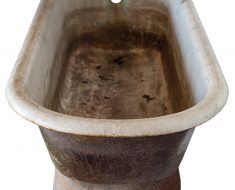
His proposed method was essentially embalming followed by electroplating. The body would first be prepared in the usual fashion, with the blood removed and preservative fluid introduced. It could then be placed in a nickel, silver, or gold bath and coated just as any other object would be. The metallic shell, he argued, would hermetically seal the body from air and “it would keep for ages.”
The silver plater imagined an entire luxury funeral market growing from the idea.
“An ancestor who died leaving one a snug fortune would be entitled to a quadruple gold plate, or at least a triple silver plate,” he suggested. “Men of means would provide in their wills for the style of plating. They also indulge in little pleasantries about setting up the silver plated ancestors on pedestals on a sort of family gallery of statuary.”
All it would take would be a wealthy deceased customer with a unique vision of an earthly afterlife, though Downing had little hope he’d find one, “unless it be some crank who leaves directions for such treatment of his body in his will.” And if he had, he claimed, “I would have nothing to do with such a job.”