In the late 1800s and early 1900s, Fanny Tunison of Sag Harbor, New York, (September 1867 – March 1944) made a living sewing, painting, drawing, and embroidering. But unlike other women who may have done similar work, she did it all without the use of her hands.
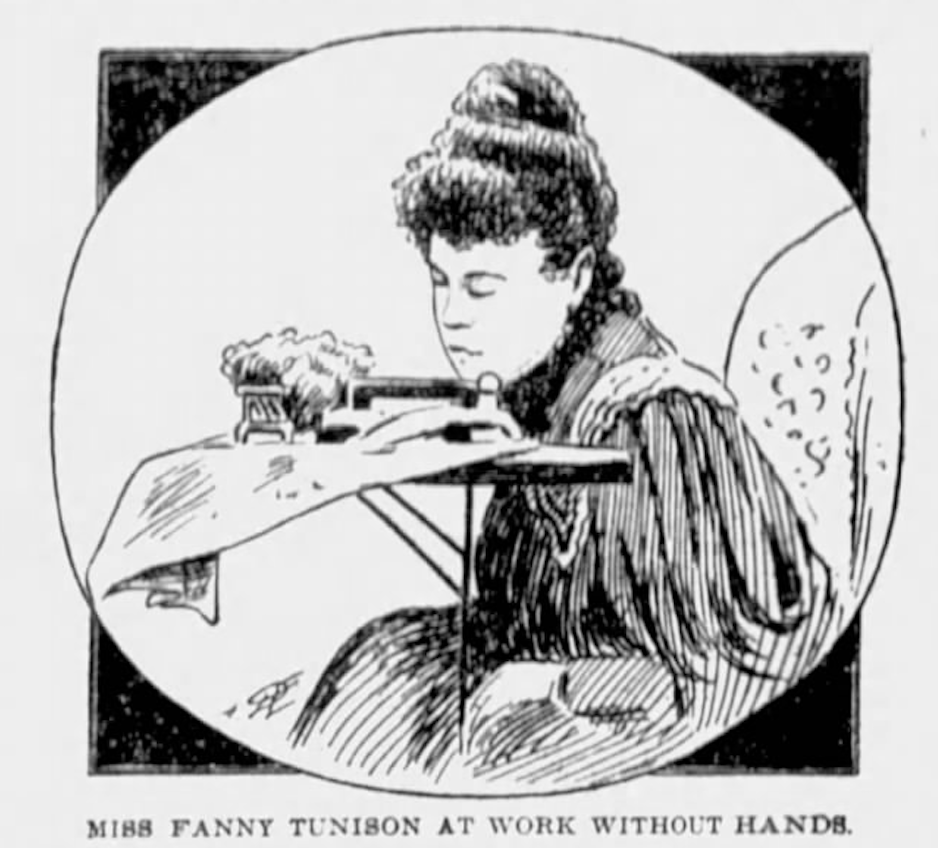
Paralyzed from the neck down since infancy, Tunison learned to use her tongue to accomplish tasks that most people couldn’t imagine doing without their fingers. Seated in a specially constructed chair built by her carpenter father, she worked at a small table, picking up needles, threading them, and sewing intricate designs. She could even tie knots in thread using her tongue. Her lower jaw and neck reportedly became “abnormally large” due to its unusual workload.
According to an 1896 newspaper account, Tunison held a needle between her tongue and upper teeth, then picked up the thread with her tongue and guided it through the eye. She also worked with scissors, holding one side against the table while using her tongue to operate the other. As a 1908 article noted, she cut paper into “beautiful flowers.”
Her talents also extended into oil paintings, watercolors, crayon sketches, and decorative household items. She even practiced pyrography, the art of burning designs into wood, and played musical instruments. Her work was exhibited at fairs, including the 1893 Chicago World’s Fair, and reportedly won first prize at the Minnesota State Fair.
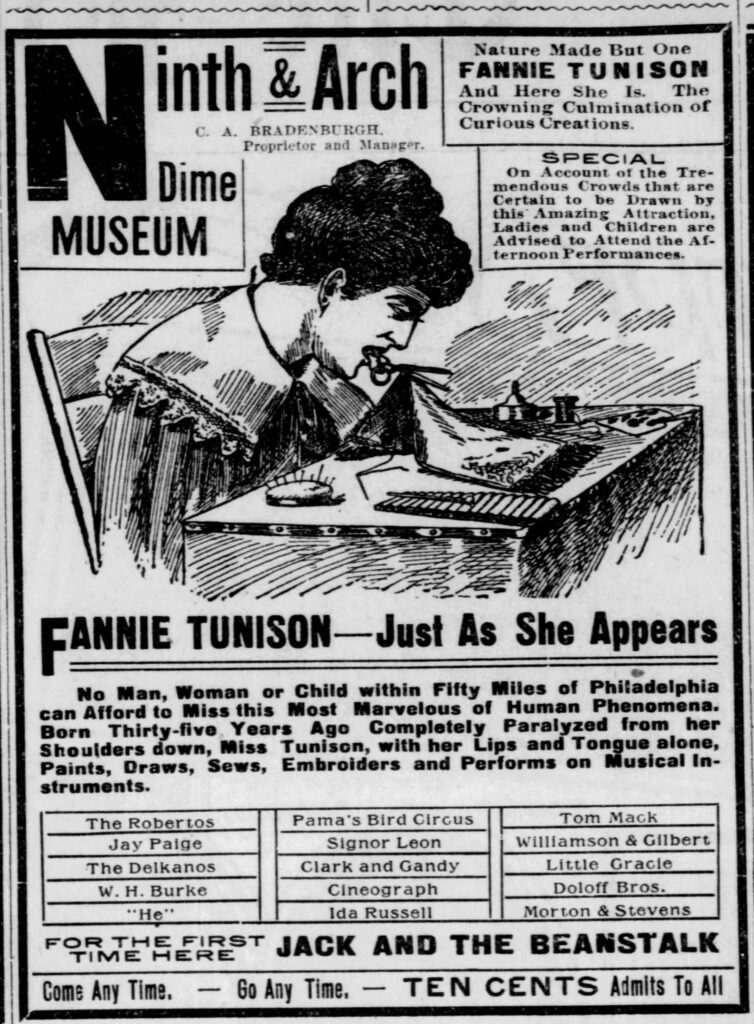
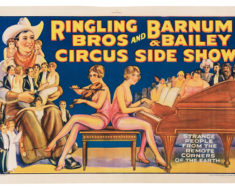
Tunison’s remarkable abilities attracted admirers from around the country. She reportedly earned $200 to $300 a year selling her creations and also made appearances at dime museums. Some reports even claim she dabbled in fortune telling later in life.
As one 1902 ad for the Ninth and Arch Dime Museum in Philadelphia proclaimed, “No Man, Woman or Child within Fifty Miles of Philadelphia can Afford to Miss this Most Marvelous of Human Phenomena.”
Despite the extraordinary challenges she faced, Tunison was described as happy, hardworking, and devoted to her craft. “Though her malady is a spinal one, which is absolutely incurable, Miss Tunison seems as happy and lighthearted a young woman as one would wish to see,” one newspaper wrote in 1896. “Everybody in the village of Sag Harbor knows her, and all say that there are few people who are as uniformly cheerful.”