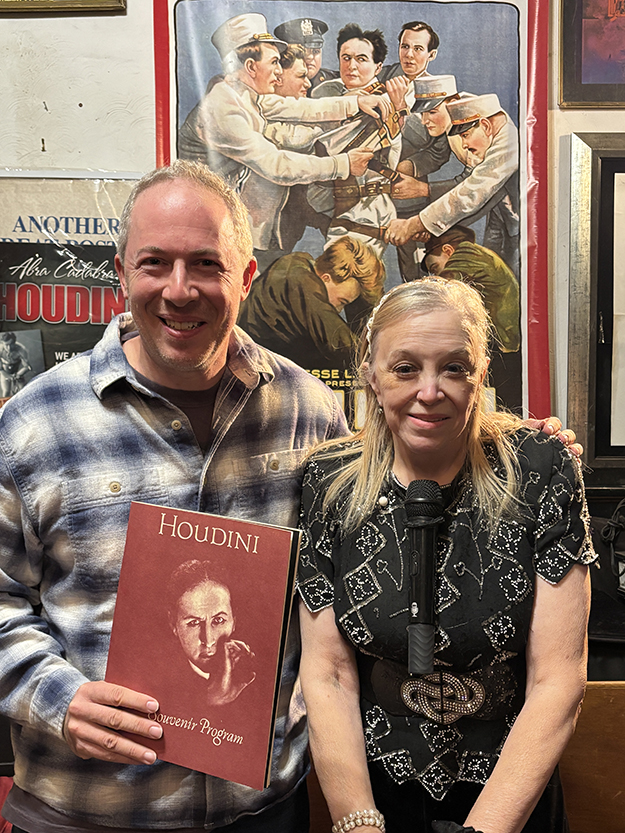
I’d never been to Scranton, Pennsylvania, before, but when there’s a Houdini Museum there, you make the three-hour drive to Scranton.
The museum is run by Dorothy Dietrich and Dick Brookz, who have dedicated decades to preserving the legacy of the world’s most famous magician and escape artist. But Dietrich’s own story is nearly as fascinating as Houdini’s.
She’s a highly accomplished magician who broke a few glass ceilings along the way to achieving her fame. She became the first woman to saw a man in half, performed the notoriously dangerous bullet catch (and lived to tell about it), and became the first woman to escape from a straitjacket while suspended upside down by a burning rope, 15 stories above the ground.
And she did it all after being inspired by Houdini as a young girl.
Dorothy grew up in a troubled home with an abusive father. At age twelve, she reached a point of such despair that she attempted to end her life by jumping in front of a truck. Fortunately, the driver stopped in time. Rather than simply driving away, he got out and spoke with her, encouraging her to make something of her life.
It was a conversation that changed everything.
During our visit, Dietrich told us about seeing a magic show at school and being captivated by the sense of wonder it created. She wanted to understand how every trick worked. More importantly, she wanted to create that same sense of wonder for others. She soon discovered a book about Houdini written by Walter B. Gibson—a prolific writer who knew Houdini personally.
As she read about Houdini’s life, she learned that he had run away from home at age twelve. If Houdini could do it, she reasoned, so could she.
Young Dorothy began putting together her own magic shows to earn money, sometimes walking through neighborhoods and offering to perform at birthday parties she happened upon. She also took odd jobs painting houses, raking leaves, and doing whatever else might bring in a few dollars.
Eventually, she saved $3,000 and caught a ride with a friend to New York City, determined to become a magician.
After arriving, she found a newspaper listing for a room in an apartment shared by several women who happened to work in show business. Through her new roommates, she began meeting agents and making connections. But there was one problem. The agents expected her to work as a magician’s assistant.
Dietrich had no interest in being the woman who got sawed in half. She wanted to be the one holding the saw.
And that’s exactly what she became.
Over the years, Dietrich developed a reputation for daring escapes and illusions that few women, and sometimes few men, had ever attempted. She even performed the legendary bullet catch, a stunt that had ended the life of several magicians, including Chung Ling Soo in 1918 during a performance in London. Houdini himself considered the act but was warned against it and ultimately chose not to make an attempt.
Dietrich’s career also led to an extraordinary encounter with the man whose book had helped inspire it.
After one of her performances, an older gentleman approached Dietrich and complimented her stage presence. He told her she reminded him of Houdini, explaining that audiences seemed to embrace her the instant she walked through the curtain.
Dietrich thanked him, but initially assumed he was just trying to flirt with her. Then someone told her who he was: Walter B. Gibson.
Dietrich ran after him to explain the significance of his book on her path to becoming a magician. The two eventually became friends. It was a relationship that would connect her even more closely to Houdini’s world.
That brings us right back to Scranton.
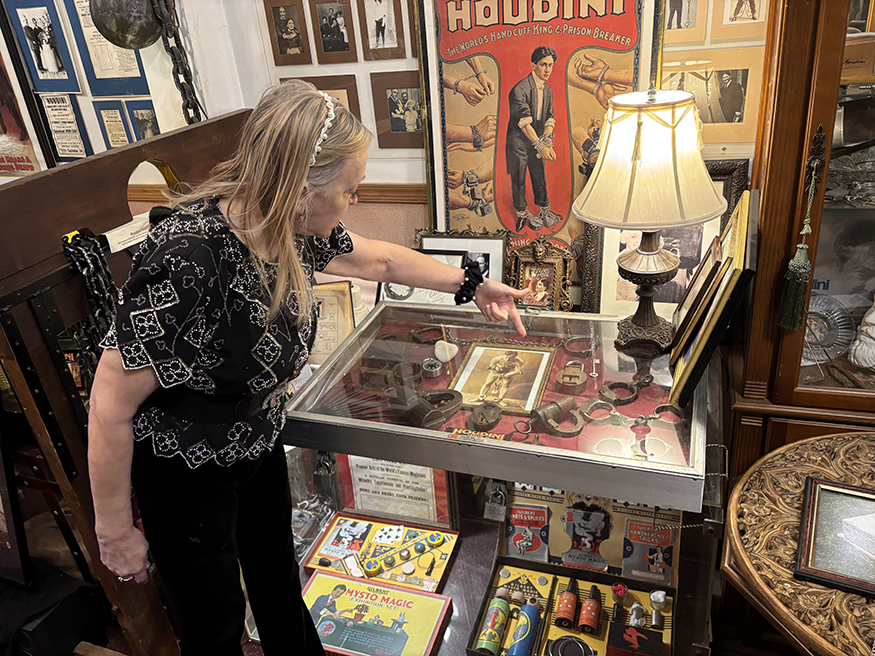
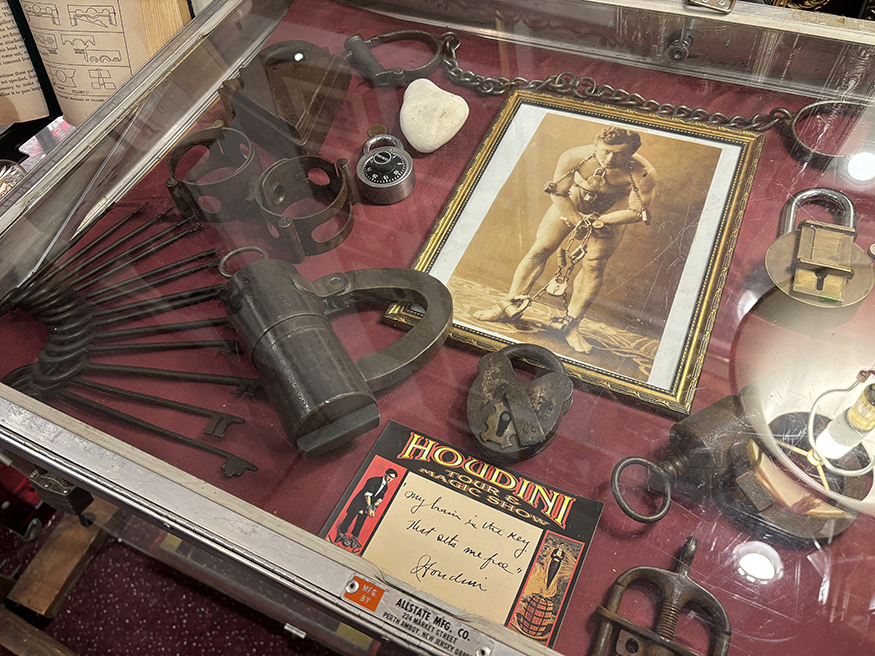
The Houdini Museum is packed with Houdiniana, from photographs, posters, and newspaper clippings to personal belongings and other artifacts documenting the escape artist’s extraordinary career. Among the treasures are locks Houdini used, some of which appear in classic photographs of him, along with original engraving blocks used to produce promotional images, theater contracts, family photos, and even a replica of the famous Mirror handcuffs.
Our visit lasted about three hours, with Dietrich guiding us and one other couple through Houdini’s life and achievements. It was much more than a walk through a museum. We were getting a history lesson from someone who had spent much of her life studying Houdini, performing many of his feats, and befriending people who had known him.
Throughout the visit, Dietrich shared anecdotes about Houdini’s remarkable talent for self-promotion. Long before social media, he understood how to generate publicity and turn ordinary events into major spectacles.
One of his favorite tactics was challenging local businesses to build something he supposedly couldn’t escape from. Rather than paying to have elaborate props constructed, he could persuade companies to provide them for the challenge. The businesses received publicity, their employees became invested in the spectacle, and Houdini drew larger crowds to his performances.
It was a brilliant arrangement. A win-win, but always a bigger win for Houdini.
Dietrich also discussed the wide range of feats that made Houdini famous, including his milk can escape, in which he was locked inside an oversized metal container filled with water. The audience watched as the seconds ticked by, knowing the magician had only a limited supply of air. Houdini understood that the secret to a memorable escape wasn’t simply getting out. It was making the audience believe he might not.
His talents weren’t limited to magic, either.
In 1910, Houdini traveled to Australia with a Voisin biplane and made aviation history. On March 18, he completed what was officially recognized as Australia’s first controlled, powered airplane flight, although earlier flights by other aviators have made the claim a subject of historical debate.
As Dietrich pointed out, Houdini’s aviation adventure was just another example of his determination to make history. He wasn’t necessarily interested in becoming an aviator, he simply wanted to accomplish something extraordinary and have his name associated with it. And once again, he succeeded.
Another fascinating story involved Houdini’s movie career.
In addition to his stage performances, Houdini starred in several silent films, including the 1919 thriller The Grim Game. For decades, the film was considered largely lost, with only fragments known to survive.
Then a print surfaced in the collection of a private owner.
Dietrich and Brookz played a role in helping bring the film back to the public, encouraging the collector to cooperate with Turner Classic Movies, which ultimately restored and presented it in 2015. It’s a piece of Houdini history that might otherwise have remained tucked away from the world.
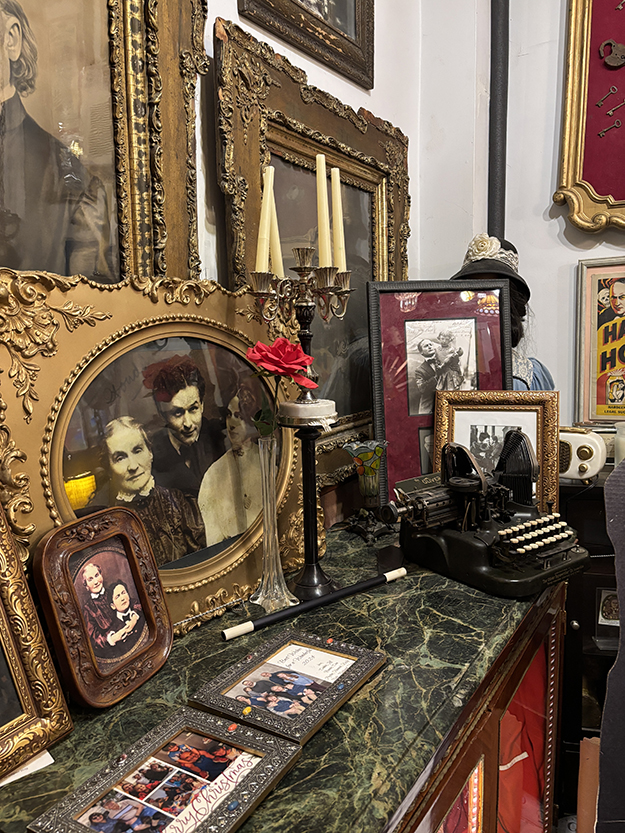
For me, one of the museum’s most intriguing artifacts is a candelabra once used by Houdini’s wife, Bess, during séances following his untimely death at age 52.
After Houdini died on Halloween in 1926, Bess attempted to contact him from beyond the veil. “Our agreement was that each year for 10 years I would take part in a séance dedicated to Harry and held for the purpose of receiving a message from him,” Bess told the Associated Press on October 15, 1936. That Halloween would mark the tenth year of seances, with a crowd of attendees gathered around a long table.
Just over two weeks later, after another unsuccessful attempt, she once again spoke with the press. “He has not come,” she said. “I turn out the light.”
Bess was done with seances, but Walter B. Gibson helped carry on the tradition for many years before passing the candelabra on to Dietrich, who continues the Houdini séances today.
It’s a remarkable connection between three generations of people dedicated to keeping Houdini’s memory alive.
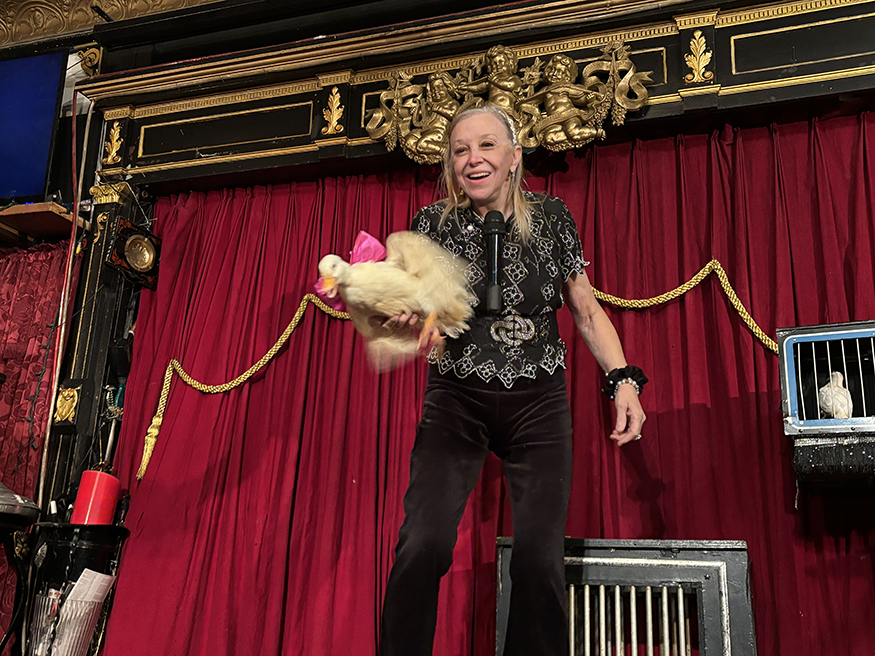
Of course, a visit to a museum run by a legendary magician wouldn’t be complete without a magic show. Among her many tricks, Dietrich conjured doves from a ribbon, materialized a duck from a flaming pan, and made a small box holding her doves suddenly house a giant rabbit.
Though Houdini has never made contact from the other side, he lives on through Dietrich’s collection, knowledge, and magic. And of course, through the countless others who’ve continued to be inspired and fascinated by his life and extraordinary achievements.
A hundred years after Houdini’s death, his spirit remains as strong as ever.